Desi Party Games: 10 That Work in a Mixed-Age Room
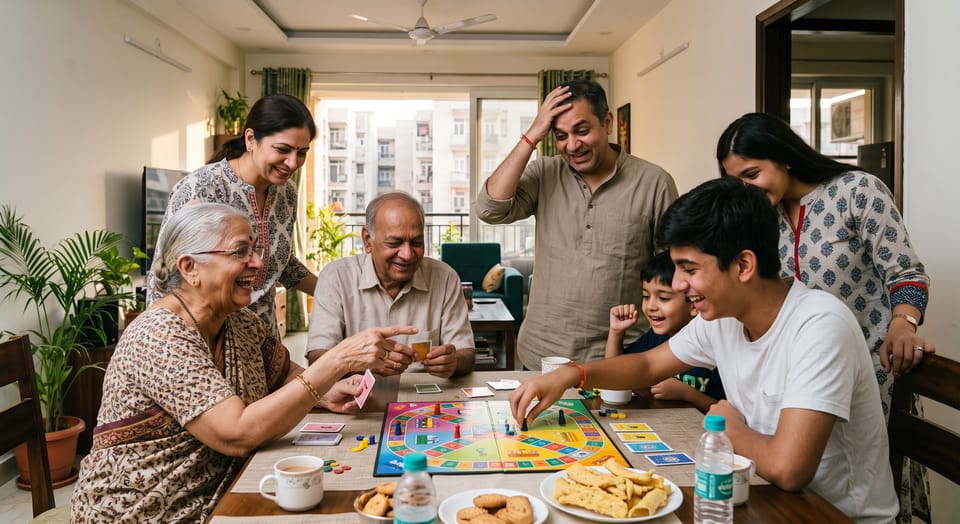
Desi party games have to survive a room where nobody shares the same references. One person knows every film released before 2000. Another knows four songs and the dance steps to two of them. A third is nine. Most party games quietly assume everyone starts level, and this room never does.
This page is one part of the full guide to Indian party games for every gathering.
The ten below are ordered by how much shared language each one needs, starting with the ones that need none. Where a game runs on film titles, you can have a generator pick them rather than asking the person with the strongest opinions.
What makes a party game work in a mixed-age room?
A party game works in a mixed-age room when knowing more does not help you win.
That one rule explains most of what fails. A quiz rewards whoever has seen the most films, so everybody else stops trying by the third question. Wordplay rewards whoever is most fluent, and fluency here is distributed by accident of birth year.
The games that hold a mixed room put the advantage somewhere it cannot be hoarded. Miming rewards nerve. Drawing rewards a bad drawing. Guessing what most people would say rewards being ordinary.
Desi party games: 10 for a room that shares no references
These run from least shared language needed to most. Start at the top and stop wherever the room stops.
1. Dumb Charades (damsharas)
Dumb Charades (damsharas) is one person acting out a film title in silence while their team guesses. It needs no language at all: a player who follows none of the dialogue can still mime a train. Hand the title choice to the Bollywood Charades generator so nobody can be accused of picking something unfair. Chennai Express (2013) is a fair opener.
2. Bollywood Pictionary
Bollywood Pictionary is the same idea with a pen: one person draws the film title while their team shouts guesses. It suits the players who will not stand up in front of a room but will happily draw badly for one. The Pictionary title generator deals the films. 3 Idiots (2009) is four minutes of somebody drawing three stick figures and getting nowhere.
3. Housie (tambola)
Housie, also called tambola, is numbers being called and marked off a ticket, and it needs no cultural knowledge whatsoever. A grandparent and a nine-year-old have identical odds, which is true of almost nothing else in the evening. Print the tickets before anyone arrives.
4. The emoji round
An emoji round is a film title spelled out in pictures for the room to read aloud. It travels across ages because emoji are the one written language everybody here actually shares. Om Shanti Om (2007) falls in about six seconds. Amar Akbar Anthony (1977) does not fall at all, which turns out to be its own entertainment.
5. Filmy Tilt
Filmy Tilt puts a title on your forehead and lets the room describe it while you guess. The guesser needs to know nothing, which makes it the kindest game to hand somebody who has just walked in. It runs on a single phone, passed around the circle.
6. The photo round
A photo round is old family photographs held up while the room names who is in them and guesses the year. It is the only game here that improves the less anyone has planned it. Younger players lose every round and stay in anyway, because the older ones start arguing and forget the score.
7. Guess Karo
Guess Karo asks you to describe something without using the three most obvious words for it. Describing chai without saying kettle, ginger or cup needs a vocabulary rather than a film library. The cards arrive pre-written, which matters: writing your own is where the difficulty gets accidentally unfair. Masala dabba, without spice-box, steel or rings, stops a room.
8. Desi Showdown
Desi Showdown is the survey game, where you guess the answers most people gave rather than the answer that is correct. Nobody can study for it, so the points land on whoever thinks most like everybody else. Ask the room to name the most iconic Bollywood Khan besides Shah Rukh Khan and watch two generations disagree. Run a round here.
9. The dialogue round
A dialogue round is one person delivering a famous line completely flat while the room names the film. Stripping out the performance is the whole game, because people remember the delivery rather than the words. A line from Sholay (1975) read like a weather forecast is the whole game in one turn.
If you would rather not pick the lines yourself, Guess the Movie from Dialogue deals them one at a time on a phone or a TV, with the film hidden until you reveal it.
10. Antakshari
Antakshari is one team ending a song on a letter and the next team starting a song with it, and it asks more of a player than anything else here. Two hundred songs in your head is not something you acquire over an evening. Split the teams so each side holds one person who grew up with the radio on.
How do you keep three generations in the same game?
Put them on the same team rather than opposite ones.
Generational teams look fair and are not. They turn every round into a verdict on whose era was better, and the losing era stops playing. Mixed teams convert the gap into an asset, because the twelve-year-old recognizes the poster and the sixty-year-old recognizes the song.
Then let people join late without penalty. Somebody is always in the kitchen, and a game that needs everybody present from the first turn gets played once.
Desi party games: questions people ask
What are the best desi party games?
The best ones are the games where knowing more does not help you win: Dumb Charades (damsharas), Bollywood Pictionary, housie, Guess Karo and a survey round. Between them they cover a room standing up, a room sitting down and a room still eating. If you prepare only one, prepare charades.
What are some desi game night ideas for a small group?
For four to six players, drop the team games and run the ones scored individually: Filmy Tilt, an emoji round and a photo round. A team of two is one person under pressure with a witness. Guess Karo holds up small as well, because the clue-giving is the entertainment. Housie wants at least six before anything feels at stake.
Which party games work when half the room does not speak Hindi?
Dumb Charades (damsharas), Bollywood Pictionary, housie and an emoji round all work with no shared language at all. Miming, drawing, numbers and pictures carry themselves. Filmy Tilt works too, as long as the person guessing is the one who speaks least. Leave out antakshari and the dialogue round. Both reward a lifetime of listening, and no amount of goodwill closes that gap in one evening.
How many people do you need for a party game like this?
Six is the floor for team games and around twenty is the ceiling before somebody has to run the evening instead of enjoying it. Below six the guessing games collapse, because one person knowing the answer ends the round instantly. Above twenty, make three teams and rotate which two are playing. Uneven teams are fine.
Is it spelled dumb charades or damsharas?
Dumb Charades (damsharas) is the correct spelling, and damsharas is the phonetic version people type after only ever hearing the name said out loud. Both point at the same game. The variants dumsharaz and dumb sharades turn up as well, and none of them changes a rule of play. Nobody has been corrected mid-round for saying it the way their family says it.
What can children and grandparents play in the same game?
Housie, an emoji round and a photo round all work across a fifty-year age gap with no adjustment. Housie because the odds are identical for everyone, the emoji round because pictures do not favor an era, and the photo round because the older players supply the material while the younger ones supply wrong answers.
Start the first round
Pick two mixed teams, agree the turn length out loud before anyone plays, then let the tool deal the first film. The only rule worth enforcing is that nobody gets to explain the rules twice.
You might also like