Indian Party Games: The Complete Guide for Every Gathering
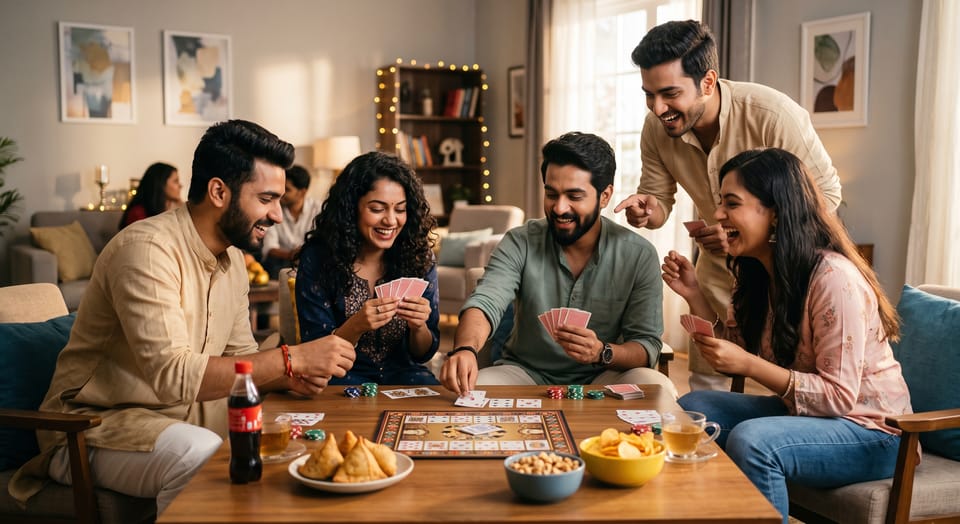
Indian party games are the games that pull a scattered family room into one activity: antakshari, dumb charades, housie, music bingo and film quiz rounds. Most people can name two of them, run out, and settle for one round of charades followed by three hours of the television. A gathering goes better with a lineup than with a single game.
Half the games on this page run on a free generator, so the titles and the words are never the part that stalls an evening. The Bollywood Charades generator deals film titles, Guess Karo hands out the words, and everything else here needs nothing but the people already in the room.
What counts as an Indian party game?
An Indian party game is any game built for the room a desi gathering actually produces: many people, mixed ages, uneven film knowledge, and a noise level that rules out anything delicate. The format can be Bollywood, musical, verbal or a survey, and the test is always the same. It has to work with a grandparent and a teenager on the same team, and it has to survive people talking over it.
Every Indian party game, ordered by what it needs
Ten games cover almost any gathering, ordered here from the ones that need nothing prepared to the ones worth setting up in advance.
- Antakshari. One team ends a song on a letter and the next team starts a song with the letter it ended on. It needs nothing but a room that has heard the same film songs, which every generation in a desi family quietly has.
- Dumb Charades (damsharas). One player acts out a film title in silence while their team shouts guesses. It is the game everyone already knows, and a generator picks the titles so nobody argues about a list they wrote themselves. Sholay (1975) opens a round; Bareilly Ki Barfi (2017) is the one that stalls it.
- Housie (tambola). Numbers are called and players cross them off a ticket until someone completes a line. It is the one game here where the youngest child and the oldest relative have exactly the same odds.
- Bollywood Music Bingo. A song plays for a few seconds and players mark it on a card. It rewards the ear rather than the memory, so a casual listener keeps pace with the superfan.
- Guess Karo. One word to get across, three obvious words banned. It moves the difficulty off cinema and onto vocabulary, so the person who has watched everything gets no head start.
- Filmy Tilt. A film title sits on one player's forehead while the room describes it and that player guesses. The guesser needs to know nothing, which makes it the round to hand a latecomer.
- Desi Showdown. A survey game, where the winning answer is the one most people gave rather than the correct one. Ask a room to name a film about friendship and half of them land on Kuch Kuch Hota Hai (1998) without conferring.
- Bollywood Pictionary. The same idea as charades with a pen instead of a body. It suits the players who will draw badly in front of a room but will not act in front of it.
- The nostalgia round. The describing game played on objects instead of films: an old advertisement, a school tiffin, a television jingle. It quietly makes the oldest person in the room the most useful one.
- Passing the parcel, film edition. A parcel moves around the circle and whoever holds it when the music stops performs a small film-themed forfeit. It is the one built for a room with children in it.
Which Indian party games work for a mixed-age family room?
Housie, antakshari and the nostalgia round work best across ages, because none of them depends on being quick or on being willing to perform. Housie runs on luck, so a child and a grandparent play it on level terms. The nostalgia round runs on memory, which is the one thing the oldest person in the room has more of than anyone else. Antakshari runs on a shared library of songs that an Indian family builds without trying, so the teenager and the grandparent contribute different decades to the same team. A room is happiest when the first game rewards something other than speed.
What are the best Indian party games for adults?
For a room of adults who have known each other for years, the games that work are the ones played sitting down: Desi Showdown, Guess Karo and the nostalgia round. A grown room will answer a question long before it will stand up and mime, so the sofa games are the ones that get played and the performance games are the ones that get suggested and quietly skipped. There is a fuller version of this for a room of adults who will answer but not perform, and a diaspora-facing take in the version written for a living room far from home.
Which Bollywood party games belong on the list?
The Bollywood games earn their place because the material renews itself. A generator can deal a fresh set of film titles every round, so charades, Pictionary and Filmy Tilt never run dry the way a written list does by its second use. Dilwale Dulhania Le Jayenge (1995) is the title to open charades with, and 3 Idiots (2009) is the one a whole room guesses at once. The full lineup, sorted by what each game asks of a player, is in the complete Bollywood party games guide.
Which Indian party games need zero equipment?
Antakshari, the nostalgia round and Guess Karo need nothing but people, and charades, Pictionary and Filmy Tilt join them as long as a generator is supplying the titles. The film list is the only part of those three that ever takes preparation, and moving it onto a generator removes the last reason to plan ahead. Housie and Bollywood Music Bingo are the exceptions worth a small setup, since both need cards, and both repay the effort by running themselves once they start.
How do you match a game to the occasion?
Match the game to how much the room can be asked to do. A kitty party wants a sit-down game that plays while people eat, which is housie or Bollywood Music Bingo. A festival evening wants something loud and communal, which is antakshari or charades. A wedding function wants a game that scales to a crowd, which is Desi Showdown or housie, and a sangeet wants the singing games ahead of everything else. A room with children wants luck over knowledge, which is passing the parcel. The occasion rarely changes the rules of a game. It changes which game you reach for first.
If you would rather hand out printed cards than pass a phone around the room, the printable Bollywood party game bundle packages six games as ready-to-print sheets. It is a paid download on Etsy rather than a free tool, and it earns its place as the backup for the stretch of an evening you would rather not run off a screen.
Indian party games: questions people ask
What are the best Indian party games?
The games that hold almost any gathering are antakshari, Dumb Charades (damsharas), housie, Guess Karo and Desi Showdown. Between them they cover a room that wants to sing, a room that wants to perform, and a room that only wants to sit and answer. Most need nothing bought, since a generator can supply the film titles or the words. If you prepare only one, prepare charades.
What Indian party games need no equipment?
Antakshari, the nostalgia round and Guess Karo need nothing but people who share the same films and songs. Dumb Charades (damsharas), Bollywood Pictionary and Filmy Tilt count too, as long as a generator is dealing the titles, since the film list is the only part of those games that ever takes preparation.
Which Indian party games work for a large gathering?
Housie and Desi Showdown scale to any number, since one caller or one question serves the whole room at once. Antakshari works well with two large teams. Keep charades and Pictionary for a smaller circle, because a room of forty spends more time waiting for a turn than playing, and the energy leaks out in the gap.
What are good Indian party games for adults?
The sit-down games suit a grown room best: Desi Showdown, Guess Karo and the nostalgia round all let a player win without standing up. Adults who have known each other for years will answer long before they will perform, so open with a game that asks for an answer and save charades for later, once nobody is keeping score of who looked silly first.
Which Indian party games suit children and mixed ages?
Housie and passing the parcel work best with children, because both run on luck rather than knowledge and a six-year-old has the same odds as an adult. The nostalgia round pulls in grandparents, who tend to know the old advertisements and jingles nobody else can place. A mixed-age room is happiest when at least one game does not reward being quick.
What games work for a kitty party?
A kitty party wants games that play while people are still talking and eating, which points to housie, Bollywood Music Bingo and Desi Showdown. All three let a player stay in a conversation and still keep up, and none asks anyone to stand in the middle of the room. Housie in particular has been the backbone of the kitty party for decades for exactly this reason.
How many games does one gathering need?
Three or four, drawn from different parts of this list rather than four versions of the same idea. One game runs about twenty minutes before a room wants a change, and the switch between games eats another ten. Pick one that needs nothing, one that runs on a generator, and one you set up in advance. The prepared one is usually the one people remember.
Is it spelled dumb charades or damsharas?
Dumb Charades (damsharas) is the correct spelling, and damsharas is the phonetic version people type after only ever hearing the name said out loud. Damsharaz and dumb sharades show up as well. None of the spellings change how the game is played, and any charades generator handles the game under whichever name you searched.
Start the first round
Pick two teams, agree the turn length out loud, and open with whichever game here asks the least of the room. By the time charades comes round, the generator already has the first title ready.
You might also like