
Indian Family Feud: 10 Questions With Answer Boards
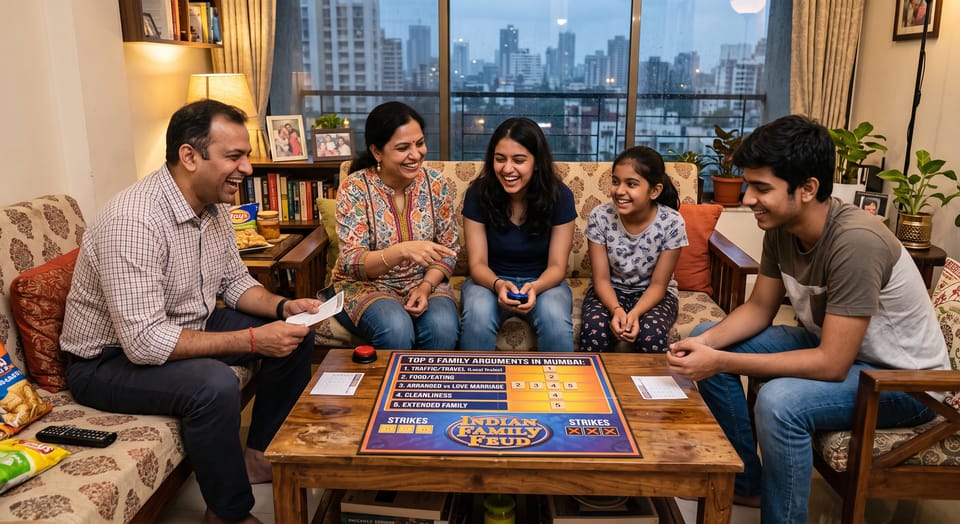
Indian Family Feud is the survey game played with questions a family actually argues about. Two teams, one board of five ranked answers, three strikes, and then the other side gets one chance to steal. The format travels fine. The questions are what usually go wrong.
The ten boards below carry their real answers and their real point values, so a room can play straight off this page. Every one of them also sits in the pool the Desi Showdown generator deals from, which means the page and the tool will never send your family in two different directions.
What is Indian Family Feud?
Indian Family Feud is a desi version of the survey game Family Feud, in which two teams try to guess the five most popular answers to a question about food, weddings, films or family life. The points work exactly as they do in the original. The subject matter does not.
That swap is the whole game. A board asking about prom night gets four blank faces. A board asking what a persistent relative will ask you at a family gathering gets four answers shouted over each other before you have finished reading it.
How do you play Family Feud with an Indian family?
Split the room into two teams, read the question out loud, and let the first team to answer play the board. They keep guessing until they find all five answers or collect three strikes. On the third strike the other team gets one guess to steal everything on the board.
Points sit on the board in order, 25 for the top answer down to 5 for the fifth. First team to 250 wins.
Agree the round length before the first question rather than during the third. Sixty seconds suits a room that knows the game. Ninety or a hundred and twenty is kinder to a group with grandparents on one team and teenagers on the other, which is the situation this game is best at.
Read out the answers nobody got. Half the argument happens after the board closes.
Family feud questions for Indian families, starting at home
The strongest boards are about the house everyone grew up in, because nobody has to think. They only have to be faster than the other team.
What is a superpower every Desi mom seems to have?
- Finding lost items (25)
- The stare that stops you in your tracks (20)
- Knowing you are lying (15)
- Making perfectly round rotis (10)
- Bargaining (5)
Open with this one. It is the board where a quiet team discovers it can shout.
Name a way parents show affection without saying "I love you".
- Asking "Have you eaten?" (25)
- Cutting fruits for you (20)
- Packing your lunch (15)
- Calling you multiple times when you are out (10)
- Bragging about you to relatives (5)
This board goes quiet for a second before it gets loud. Let it.
Name a sign that guests are coming over.
- Frantic house cleaning (25)
- Special food being cooked (20)
- The good crockery comes out (15)
- Mom is more stressed than usual (10)
- You are told to change into good clothes (5)
Name something a persistent aunty will ask you at a family gathering.
- When are you getting married? (25)
- How much do you earn? (20)
- Have you lost or gained weight? (15)
- Do you remember me? You have become so big. (10)
- What are your future plans? (5)
The top answer here is almost never guessed first. Everyone reaches for the weight question.
Desi family feud questions about weddings
Wedding boards get the loudest, because everyone in the room has been to the same wedding and remembers a different part of it.
Name the most chaotic part of a wedding.
- The Joota Chupai, hiding the shoes (25)
- The Baraat, the groom's procession (20)
- The buffet line (15)
- The group photo session (10)
- The Vidaai, the bride's farewell (5)
Name a song that is almost guaranteed to be played at a Sangeet.
- London Thumakda (25)
- Maahi Ve (20)
- Kajra Re (15)
- Gallan Goodiyaan (10)
- Mehndi Laga Ke Rakhna (5)
Name a gift that is commonly given to the newlywed couple.
- Cash in an envelope, shagun (25)
- A dinner set (20)
- A wall clock (15)
- Bed sheets (10)
- A home appliance, a mixer or a toaster (5)
The wall clock at fifteen is the one teams talk about afterwards. Nobody has ever bought one on purpose and everyone has received four.
Family feud questions about Bollywood and being a 90s kid
Film and memory boards split a mixed-age room usefully. The younger team knows the recent answers and the older team knows the top one.
Name something every 90s Bollywood movie had.
- A wedding song sequence (25)
- Hero named Rahul or Raj (20)
- Dancing in Switzerland or in the rain (15)
- A disapproving rich father (10)
- Multiple outfit changes in one song (5)
Name a movie that is super rewatchable.
- Dilwale Dulhania Le Jayenge (25)
- 3 Idiots (20)
- Jab We Met (15)
- Yeh Jawaani Hai Deewani (10)
- Zindagi Na Milegi Dobara (5)
If the room is still naming films twenty minutes after this board closes, hand the night over to charades and let them act the titles out instead.
Name an outdoor game you played after school.
- Hide and Seek, Chhupan Chhupai (25)
- Cricket (20)
- Lock and Key, or Statue (15)
- Lagori, or Pithu (10)
- Kabaddi (5)
Give this board to a team with children on it.
Indian Family Feud questions people actually ask
How many people do you need to play Indian Family Feud?
Four is the minimum that works, two teams of two, and six to twelve is the range where it plays best. Below four there is nobody to argue with. Above about sixteen, split into three teams and rotate which two are on the board, otherwise most of the room spends the evening watching. Uneven teams are fine, because the bottleneck is agreement rather than numbers.
What are good family feud questions for Indian families?
Good questions are about shared household experience rather than facts. What a parent says, what gets bought in bulk, what happens when guests arrive, what people do at a wedding. Each of those gives a room five answers it can reach without thinking. Avoid anything needing specific knowledge, including regional questions only half the family can answer. The test is whether a fourteen year old and a seventy year old can both shout something plausible within three seconds of hearing it.
Are there Indian Family Feud questions that work with kids?
Yes, and the ones that work are about play and school rather than adult life. Boards about outdoor games, tiffin contents, cartoons and snacks let children compete on equal terms, which is rarely true in a family game. Keep the round at ninety seconds or longer for a team with young players, and let them answer first rather than second.
Can you play Indian Family Feud at an office party?
Yes, and it works better than most office games because it needs no preparation from the players. Keep the boards on food, films and nostalgia and leave the family and marriage questions out, since those land differently at work. Teams of four or five, sixty second rounds, and a host who is not competing. State once, before the first board, that the host decides disputes.
What is the difference between Indian Family Feud and Desi Showdown?
Desi Showdown is the online version of the same game. The rules are identical: two teams, five ranked answers, three strikes and a steal, first to 250 points. The difference is that Desi Showdown deals the questions and keeps the score, so nobody has to host with a printed sheet, and it offers themed question packs plus a Masala Mix that draws from all of them.
Play a round now
Name the two teams, pick a round length, and let the generator deal the first question. It handles the strikes, the steal and the score, which leaves the host free to do the only job that matters, reading the answers out slowly enough for the room to react.
You might also like